
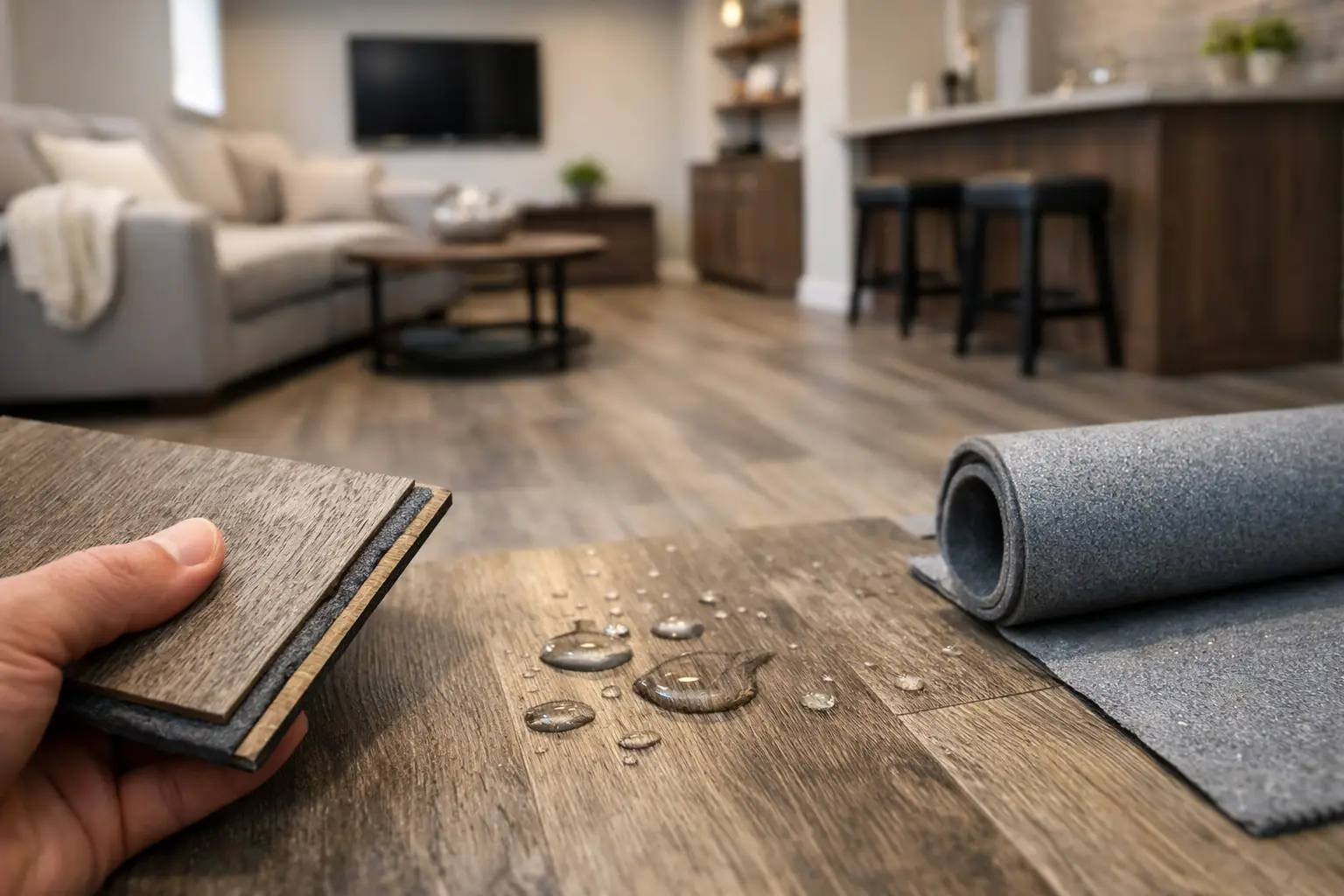
A finished basement can be a family room, play space, home gym, guest suite, or all four over time. But the floor has to handle a condition that upstairs rooms rarely face: moisture moving through concrete, small spills near exterior doors, and the occasional plumbing surprise. This waterproof basement flooring review looks at the materials that hold up best in real homes, along with the installation details that determine whether the result lasts.
The right choice is not simply the floor labeled “waterproof.” It is the material that fits your basement’s moisture conditions, how you use the room, your comfort preferences, and the level of finish you want from the space.
What “Waterproof” Really Means in a Basement
A waterproof flooring surface will not absorb water or swell after exposure to a spill. That is valuable, but it does not mean the entire basement floor system is protected from every moisture problem. Water can still enter through a foundation crack, travel at wall edges, collect beneath floating flooring, or cause problems with adhesives if the concrete slab has high moisture vapor.
Before choosing a finish material, address active water issues first. A wet basement needs drainage, grading, foundation repair, plumbing repair, or a combination of solutions before it needs new flooring. Installing a beautiful floor over an unresolved leak can hide the problem for a while, but it will not solve it.
For a dry basement with normal concrete-slab moisture, waterproof flooring gives homeowners a practical margin of safety. It also makes everyday cleanup far easier, especially in spaces used by children, pets, or guests.
Waterproof Basement Flooring Review: The Best Options
Luxury vinyl plank, porcelain tile, and epoxy-coated concrete are the strongest choices for most finished basements. Each has a different look, feel, cost profile, and installation requirement.
Luxury Vinyl Plank and Luxury Vinyl Tile
Luxury vinyl plank, often called LVP, is the most common choice for finished basement living areas. Its waterproof core and wear layer make it resistant to spills, damp shoes, pet accidents, and typical basement humidity. It can also create the warm appearance of hardwood without exposing real wood to below-grade moisture risks.
For homeowners who want a comfortable family room or a polished basement lounge, LVP offers an excellent balance. It is warmer and softer underfoot than tile, and it works well with area rugs and basement furniture. Many products use a click-lock floating installation, which can allow for simpler repair if a section is damaged.
The trade-off is that vinyl needs a relatively flat, clean slab. High spots, low spots, or rough concrete can cause joints to separate or create movement underfoot. A quality underlayment may improve comfort and help manage minor slab irregularities, but it is not a cure for standing water or significant vapor issues. Product specifications matter, especially when selecting an underlayment or moisture barrier.
Luxury vinyl is often the best all-around pick for a basement rec room, office, media room, or multipurpose space. Choose a quality product with a durable wear layer rather than making a decision based on color alone.
Porcelain or Ceramic Tile
Porcelain tile is one of the most durable waterproof basement flooring materials available. It does not swell, dent easily, or lose its appearance when exposed to water. For basement bathrooms, laundry areas, wet bars, mudroom-style entry points, and high-traffic spaces, tile is hard to beat.
Porcelain is usually preferred over ceramic for basement projects because it is denser and less porous. With proper installation and grout, it creates a long-lasting surface that can complement almost any design direction, from clean modern concrete looks to traditional stone or wood-look tile.
Its main drawback is comfort. Tile feels cold and hard underfoot, particularly on a concrete slab during an Illinois winter. Area rugs help in living zones, while in-floor heating can add significant comfort when the budget and project scope allow. Tile installation also demands careful substrate preparation. Cracked or uneven concrete may require crack isolation or leveling work before tile is installed.
Homeowners who prioritize long-term durability and a premium finish often find tile worth the investment. It is particularly well suited to basement bathrooms where water resistance is non-negotiable.
Epoxy-Coated Concrete
Epoxy creates a durable, water-resistant coating directly over a prepared concrete slab. It is a smart option for utility rooms, workshops, home gyms, storage spaces, and modern industrial-style basements. The finish is easy to clean and can be customized with solid colors, decorative flakes, or metallic effects.
Unlike floating vinyl flooring, epoxy does not create a separate layer where water can become trapped beneath the surface. However, epoxy’s performance depends heavily on preparation. The slab must be clean, sound, dry enough for the product, and properly profiled so the coating bonds correctly. Moisture vapor pushing up through concrete can cause peeling or blistering if it is not tested and addressed beforehand.
Epoxy is also harder than vinyl and can become slippery when wet unless a non-slip additive is included. It may not deliver the warm, residential feel homeowners want for a main family space, but it is an efficient and attractive option when function leads the design.
Sheet Vinyl
Sheet vinyl remains a practical budget-conscious option for certain basement areas. Because it can be installed with very few seams, it offers strong water resistance and easy maintenance. It is softer than tile and available in a wide range of colors and patterns.
The limitation is appearance and repair. While modern sheet vinyl has improved, it generally does not provide the high-end look or individual-plank replacement flexibility of luxury vinyl. It also requires a smooth subfloor, since imperfections in the concrete can telegraph through the material over time.
For laundry rooms, secondary basement spaces, or projects where keeping costs controlled matters most, sheet vinyl can be a sensible choice.
Flooring Materials to Approach Carefully
Solid hardwood is not recommended below grade. Wood naturally expands and contracts with moisture changes, and basement conditions make cupping, warping, and gaps more likely. Even engineered hardwood, while more stable than solid wood, can be a higher-risk choice unless the basement is consistently dry and the product is specifically approved for below-grade installation.
Traditional laminate has also caused plenty of basement headaches. Some newer products claim water resistance, but many laminate cores can swell when water enters through seams or reaches the edges. For a basement that will be used regularly, waterproof vinyl generally provides a safer wood-look alternative.
Carpet can be comfortable, but it is not waterproof. If homeowners want carpet in a dry basement, modular carpet tiles are often a more practical option than wall-to-wall carpet because damaged tiles can be removed and replaced. A moisture-resistant pad and careful attention to slab conditions are still necessary.
The Installation Details That Protect Your Investment
The material is only half the decision. Professional installation begins with evaluating the slab. That includes checking for visible cracks, uneven areas, past water damage, and moisture vapor concerns. A floor may look dry on the surface while still releasing enough moisture to affect adhesives or coatings.
Expansion gaps, transitions, wall-edge details, and the right underlayment all matter with floating floors. Tile needs proper crack protection, thinset selection, and grout work. Epoxy requires intensive surface preparation that cannot be skipped without risking early failure.
If the basement has had water in the past, plan for the possibility of future service. A floating LVP system can be easier to remove and reinstall after a minor water event than a glued-down floor. Tile may survive water well, but repairs to the surrounding system can be more involved. The best option depends on both the likelihood of moisture and your tolerance for future disruption.
How to Choose for Your Basement’s Use
For a comfortable finished family room, luxury vinyl plank is usually the strongest value. For a bathroom, wet bar, or laundry area, porcelain tile provides exceptional water resistance and longevity. For a gym, workshop, or utility-focused room, epoxy can deliver a tough, easy-care surface. If budget is the primary driver, sheet vinyl deserves consideration in the right space.
It also helps to think beyond the floor sample. Consider ceiling height, existing doors, floor drain locations, whether the room needs added warmth, and how the flooring will transition to stairs or adjacent rooms. These details shape both the final appearance and the day-to-day comfort of the basement.
A well-planned basement floor should support the way your household actually lives, not just look good on installation day. At JG Home Services, careful material selection and detailed preparation help homeowners create finished basements that feel dependable, comfortable, and ready for years of use. The most helpful next step is to assess the slab and moisture conditions before falling in love with a specific color or style.